How Right To The City is bringing non-extractive investment into the fight for housing justice and community ownership
“We could just run these buildings ourselves.”
Chloe Jackson wasn’t originally any sort of organizer. In 2013, she was still just a single mom in a new city, raising a seven year old boy while working at the Mall of America in the Minneapolis suburbs, and looking for a new apartment in the city. She wound up in one of a cluster of five buildings in the Corcoran neighborhood owned by Stephen Frenz, a landlord with vast holdings across the city—and not a lot of attention to the needs of his tenants.
Chloe noticed some of this neglect the day she moved into her unit: “it was leaking water, the carpet wasn't laid down.” But maybe it was just bad luck, and anyway, what could she do about it?
Meanwhile, the unexpected knocks on her door kept coming.
Those knocks were from some very persistent tenant organizers from Inquilinxs Unidxs por Justicia (IX), canvassing buildings like Chloe’s. At first, Chloe didn’t engage. As she relates, “I didn't know anybody here in Minnesota, so I was like, no one should be coming to my door.” But eventually they wore her down, and she decided to just go and check out one of the tenant meetings they were convening, to see what they were all about. What she heard told her she was far from alone, and that she could indeed do something about it:
There were a lot of people from a lot of different buildings, some were even from my building, and on the same block where I was living. And people just all had the same stories: a lot of repair issues, a lot of pest control issues. The landlord was just taking advantage of people of color, people who didn't speak English. It was just crazy to me. And I kind of got involved from there.
Chloe jumped headfirst into a fight that would make history, organizing alongside the other residents of the five buildings in Corcoran. This was a long, drawn-out fight—and a complicated one, when the city of Minneapolis revoked Frenz’ rental license in 2017 with no clear sense of what that meant for his buildings or his tenants. Chloe shares an example of how this forced her and her neighbors into action: “our water was almost cut off. We went downtown to the city and paid the water bill, and was like, hey, y'all did this. Y'all took his license without a plan on how to protect us.” Emboldened by the crisis, the tenants in Corcoran began to realize: “we could just run these buildings ourselves. Let us be the owners.”
César Atienzo, a cultural organizer with IX, explains that for him—and for many of the immigrant tenants in the Corcoran buildings—experiences outside of the US made it easier to believe that a better way of living together in the city could be possible:
I'm originally from Mexico City, and when I was growing up, I didn't realize how lucky we were until I moved to the United States. I grew up in a very large social housing development in Mexico City, a huge project with a combination of both buildings and family housing, with access to schools, clinics, and open green areas. It was affordable housing for everybody, and it was a really interesting combination of folks with middle class, and really lower class residents, and I didn't realize how good we had it until I started realizing how housing is becoming such a commodity in the world, making it really difficult to have affordable housing.
With things in legal freefall, a tenant takeover, under cooperative ownership, emerged as a real possibility to fight for. “IX encouraged us: if you want to be the owners, you can do it, we'll figure it out together—and that gave us hope and gave us strength to want to be owners,” Chloe explains. “Let's just do it. We're going to try it, we're going to do it.”
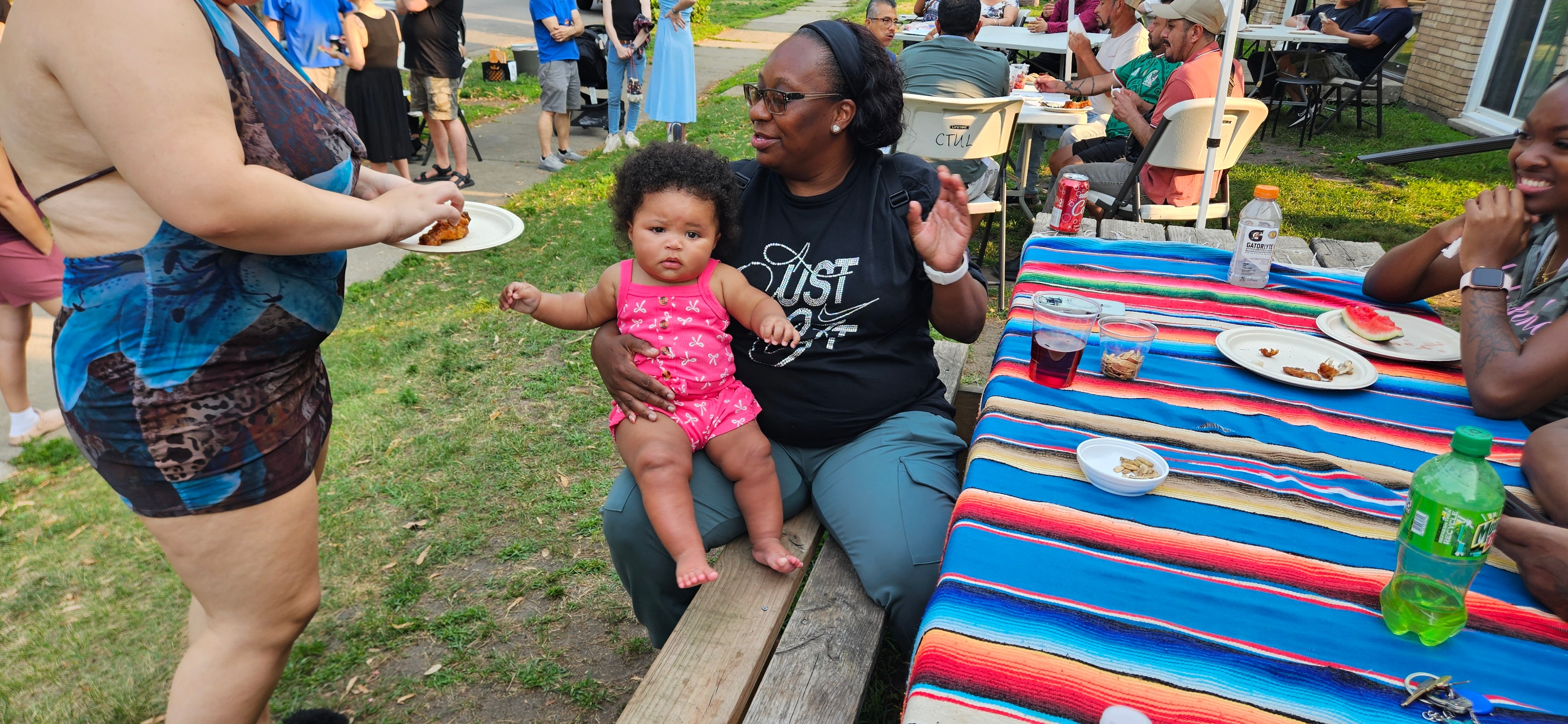
Chloe Jackson and her granddaughter enjoying a picnic at the cooperative.
This wasn’t easy—Frenz still owned the properties, despite his legal inability to rent them. Chloe explains how he dug his heels in: “There was a series of negotiations with Steve Frentz for us to obtain these buildings, and at some point, he just stopped talking to the tenants, and was like, you know what, no, I'm not gonna deal with you all.” The tenants kept up the pressure, though, showing up outside his house, marching on the church he attends, all the while dealing with the chaos and promise of an unprecedented situation. Chloe shares just how wild and up for grabs everything was:
Back in 2018, I called this our lawless times, because it was lawless, seriously. We didn't have a property management company, we didn't have an owner, folks weren’t paying rent, and we had to protect the buildings. There's a lot of unhoused community members here, and people could just come off the street and just break into the buildings, and try to squat in a vacant unit. Out of the 69, 34 were filled, so we have 35 vacant units that we had to figure out how to make sure that people who aren't supposed to be here, don't come. And when they did come, we went and had a conversation with them, told them what we were doing, what we were trying to build, and how their squatting is affecting that, especially if they were partying, smoking and drinking, causing a ruckus. Now, there were some who just needed a place to stay and were ready to be down with the project. We were like, okay, well, we're not paying rent anyway, but, you know, if you want to be a part of something bigger, this is how you can get involved. And there’s a person that showed up and came to meetings, and is still here.
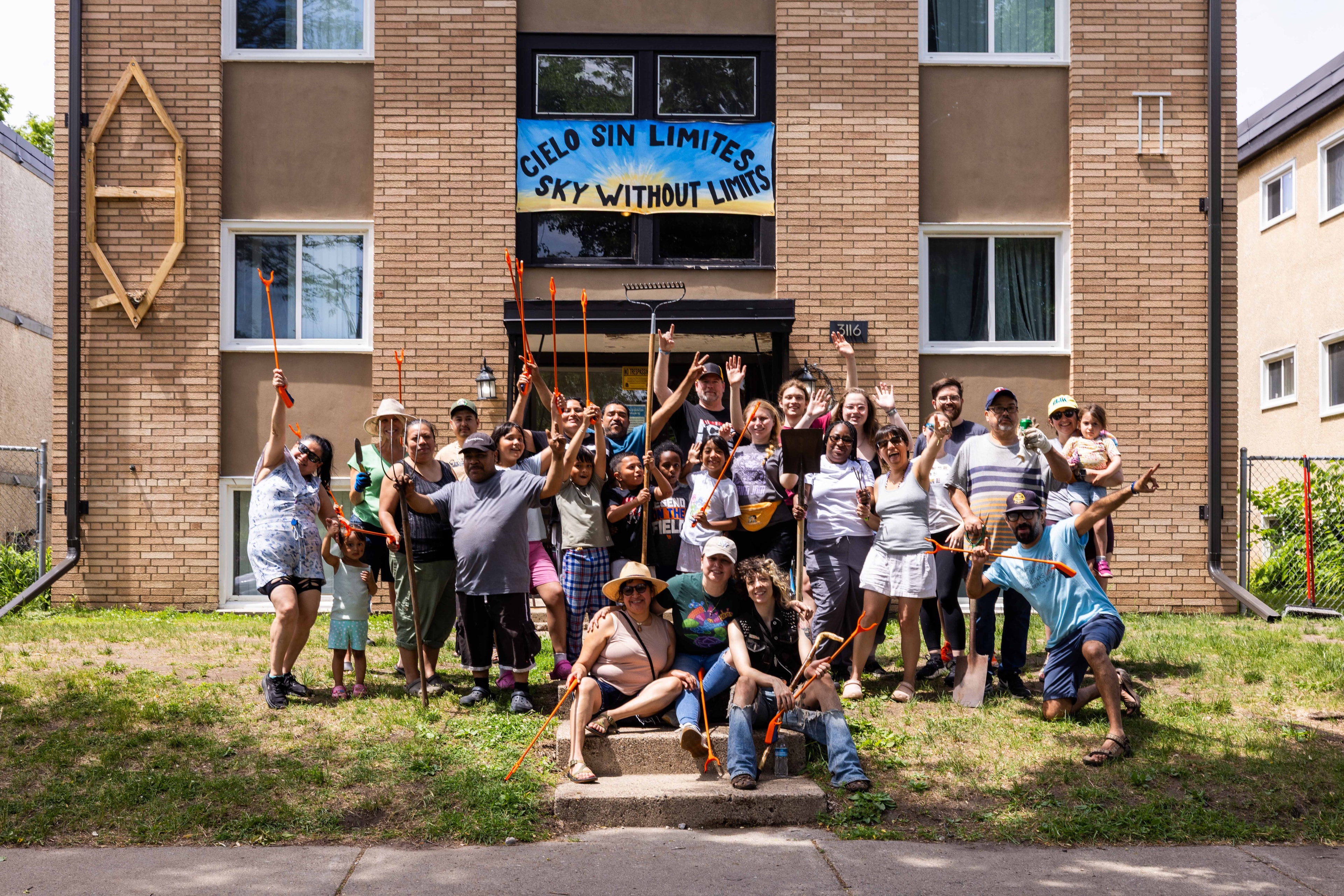
In 2020, as the pandemic raged, things finally came to a head. Frenz had gone to court to evict Chloe, a prelude to evicting everyone else. And then, in a minor miracle, he lost that case, and looking to cut his losses, struck a deal to sell the properties immediately to Land Bank Twin Cities, with LISC and the city of Minneapolis stepping in with financing. The land bank would hold the properties until the tenants were in a position to purchase them as a cooperative, which they named Sky Without Limits. With IX’s help, Chloe and her neighbors had, against all odds, won.
For Chloe, however, this victory was just the beginning:
So, to me, the feeling was just like, oh, okay, we did something. Now what's next? This was the easy part. The hard part is building out the cooperative. What do we have to do? How are we gonna do it? Who needs to be where? Where are we going to get this help from? How are we going to get the money to buy the buildings back from the land bank who's holding the properties for us. We're talking about millions of dollars, who is going to come up with this?
IX was doing campaigns, building tenant power, organizing people to fight back, but it didn't have an in-house cooperative development department just waiting at the ready for an opportunity like this. The infrastructure needed to be built, on the fly, and millions in dollars of financing needed to be lined up. But IX also had a secret weapon here—they were a member of Right to the City, a national network of housing justice organizations. César explains:
Right to the City has been critical for us to be able to move into creating the cooperative. In order for us to be able to tap into funding, we needed to have our due diligence. We needed to make sure that we had everything, every single piece in the right place, and Right to the City was able to help us to do that, and make connections with other projects going on in the United States.
Mike Leyba is the National Organizer for Capital Strategies at Right To The City, an alliance of around 70 organizations like IX all around the country that is quickly approaching its 20th anniversary. “We came out of this moment in the early 2000s,” explaining their roots in the run up to the financial crisis, “where organizing was happening in a lot of our communities around subprime lending and people in foreclosure.” The playbook across the alliance’s members, including at City Life/Vida Urbana in Boston, where Mike was just beginning to learn the power of organizing at the time, was similar: build power and leadership through deep organizing in the communities most harmed by the speculative real estate regime, then use that power to take on the banks and other bad financial actors driving the crisis, by staging protests, blocking evictions, or demanding action from elected officials. But these oppositional tactics weren’t enough on their own. Mike explains that: “we were really trying to figure out how to keep people housed, in place and in their communities, and so we started exploring the idea of a community land trust. Our relationship to community land trusts and to community ownership came out of necessity from our organizing campaigns.”
RTTC’s interest in the creation of permanently affordable, community controlled housing in turn raised the question of capital. How could the alliance as a whole help its member organizations access the financial resources needed to take on these kinds of projects? Mike explains how the members of the alliance identified the role a shared fund could play in helping close these financing gaps:
The Right to the City Fund began as a member initiated project. We have these big leadership assemblies every year, and in 2019, the leadership assembly identified some barriers that they were facing when it came to removing land from the speculative market. Member leaders identified access to capital and resources for acquisition and redevelopment as one of the challenges that local groups were facing. Out of this conversation there was a proposal to explore the possibility of establishing a loan fund as a strategy to help us organize those resources, and really support member organizations that were trying to establish permanently affordable and democratically governed housing.
RTTC didn’t need to start from scratch, however. National infrastructure for a movement-oriented, non-extractive loan fund was already being built and refined by Seed Commons, itself beginning to take a more serious interest in how to support community controlled land and housing initiatives due to the antidisplacement work of members like Asheville’s PODER Emma. Mike relates how, following the mandate from the RTTC membership “we reached out to Seed Commons in 2020 to begin conversations about what that would look like, and ended up joining Seed Commons in 2021.” Their membership allows them to take advantage of the economies of scale built into the Seed Commons model, and crucially allows them to focus on organizing, not financial minutiae: “The less that we have to deal with the mechanics of loan fund administration and legal compliance, the more that we're able to actually offer strategy support, consulting hours, or sounding boards for our members who are trying to get these projects off the ground, often for the first time. It helps us invest our limited time in the places that will have the greatest impact.”
In 2024, RTTC made their first loan as a Seed Commons member, to the Monte Vista Co-op in a rapidly gentrifying Westwood neighborhood in Denver, Colorado. A decade-long fight by RTTC member 9to5 Colorado had laid the groundwork: working alongside local mobile home parks, they managed to win legislation ensuring that residents would have the first opportunity to purchase any park that went up for sale. Westwood would be a testing ground for this new anti-displacement policy framework. Residents in the 78 unit park that became the Monte Vista Co-op, who had been organizing with the help of 9to5 Colorado and another RTTC member, Justice for the People, were then able, after two years of negotiation, to become the city of Denver’s first cooperative mobile home park. RTTC’s loan, for $1.5 million, alongside local and statewide funding won through persistent resident organizing—helped make the transaction—and the community ownership precedent it established—possible.
For Mike, this kind of permanent community ownership is essential as a way of institutionalizing the hard-won victories of tenants. He explains:
People are always a little hesitant to organize as tenants, because that organizing comes with a cost, and it's a cost that not everybody can pay at all points in time. Imagine that the one place in your life that is supposed to be a refuge for you and your family is now a place of struggle: every time you clock out of work, you're returning home to a place that you're fighting for, with the management, and on all these different fronts. A lot of the tenants who we organize are people that are facing exorbitant rent increases. Even if you organize and are able to eke out a victory and get a different lease, at the end of the day, you're going to have to re-fight that fight in a year when that lease ends. So part of our perspective that, actually, we need to be able to own and have governing power over our homes came from this place of not wanting to have to fight this same fight every year, every three years, every five years when we're renewing a contract. Even if you have the most values-aligned affordable housing developer, there still needs to be some way for people to have autonomy over their homes and their places that they live.
RTTC looks a little different than most of the member organizations making up Seed Commons’ cooperatively-governed CDFI, which are for the most part strictly local, with their non-extractive lending work grounded in the place-based relationships and knowledge these members can bring to the table. While RTTC is a national alliance, it is, like Seed Commons itself, built on a membership model that starts from the same kind of deep relationships with local community, and like Seed Commons, it focuses on leveraging that foundation to build strong bonds of trust and shared commitment between place-based members and the national organization, and across the membership. Mike explains what their members bring to the table:
Our member organizations have, in my opinion, some of the sharpest perspectives on political economy—that’s more than just economics. A bank will ask you the economic questions. What's the loan-to-value ratio? Do you have enough equity in this to refinance in seven years? How does your cap stack all work? Those are all important economic business analysis questions, but our member organizations ask questions that get beyond that. What happens if a partial owner wants to sell? Is that going to force us, the residents, into this precarious place? What's the impact of not doing anything? I don't think there's a lot of organizations out there that are doing work in this kind of space that have a solid understanding of both the economics behind the real estate deal, but also the political economy and power dynamics that exists in the current system and a critique of that. We're approaching it from the perspective of wanting to do better.
RTTC taps this membership, and their hard-won insights into the political economy of land and housing, to help guide the lending work alongside their national team. Mike explains, for instance, that the credit committee for the RTTC Fund housed at Seed Commons “is currently made up of seven members of organizations that are doing community housing work.” The financial infrastructure at Seed Commons, the lender of record, then provides an extra level of due diligence: “I have experienced Seed Commons as a second set of eyes on decisions that we have made—it’s always good to have someone double check your work.”
Seed Commons also provides a bigger network of peers for the projects funded through RTTC’s loan fund to turn to with questions and challenges, as Mike highlights: “If a portfolio project needs a sounding board about a management company, or the relationship with an intermediary, or a refinancing question, or any kind of issue like that, one of the things we suggest is that they go to the monthly real estate calls Seed Commons orchestrates, because the best way to learn is from other folks who have done it, navigating those same questions. I feel like the thing that I've particularly appreciated about participating in the Seed Commons ecosystem is that kind of peer learning, peer exchange of best practices and what’s been tried.”
Movement dreams
This relationship between a national alliance of housing justice organizations and a national cooperative for non-extractive finance creates capacities for on the ground movements. It starts to let them dream a little differently, a little bigger—to imagine a world where their access to dignified and affordable housing wasn’t at the mercy of anonymous flows of speculative capital, but where on the contrary their community can control and direct those financial resources in ways that serve human needs.
Back at Sky Without Limits, that more just world is beginning to appear. When the landlord finally caved in and sold the five buildings in Corcoran, he hadn’t sold them directly to the tenants who had been out-organizing him for years. César explains what this meant in practice: “once the buildings were taken away from the landlord, and taken by the land bank, the land bank had to hire this management company. This management company, for the last five years, has been the ones running the show.” Undoubtedly, this was an improvement from the previous state of neglect and exploitation—a wave of long overdue renovations had been made to the properties, for instance. “However, when it came to the decision-making, the residents were really not really making the big decisions. People still had to organize to try to influence some of the decisions that were made by the management company.”
This all was, for Chloe, a difficult situation to navigate:
It's stressful, because you're building out something different, right? We wanted to be able to actually be Sky Without Limits. We didn’t want to have to listen to what the property management company is telling us, or what banks will require for their loans. We didn't want to do that.
But securing the cooperative autonomy the members of Sky Without Limits were looking for would first require coming up with the money to buy their buildings back from the land bank. It was not the easiest time to be focusing on real estate: the very same month the landlord surrendered the buildings, George Floyd would be murdered by Minneapolis police officer Derek Chauvin just under two miles away from Corcoran, igniting an uprising that would quickly engulf the city and then the nation, all in the middle of the pandemic. Despite the overlapping crises, Sky Without Limits, with a dramatic story of an underdog victory, was able to raise $1.6 million in donations toward the cooperative conversion—but that still left millions to raise. Chloe notes that their options were limited: “to be honest with you, we didn't even try the traditional banks and go that route, because it would have been really difficult to navigate. Like, who is actually going to be responsible for that loan? It seemed like it was going to be too hard for us to do that. The banks would have been the last, last resort.”
Working with the RTTC loan fund, alongside additional philanthropic supporters, Chloe and the rest of the cooperative were able to finally assemble a capital stack that enables them to purchase of four of the five buildings in Corcoran on terms that keep the cooperative financially viable for the long term, without extractive interest rates or onerous conditions. (They’re continuing to work towards acquiring that last piece of the puzzle.) César underscores what a turning point this acquisition has been for the tenants of Sky Without Limits:
In May of 2025, that's when people were able to experience more of this ownership of the buildings. Part of the funding that we got is to fix the buildings, and people got to decide what are the needs that we need to get done first. They hired an architectural firm and engineers, to have a very clear idea of what needs to be fixed so we can have dignified safe housing for many years. This is millions and millions of dollars of renovations, right? But, the main things were to get brand new windows, and new roofs, and the membership, they decided to get those things done. We want these buildings to last a long time, we need to have a good roof and good windows to keep energy inside and to keep water away from our buildings. And they got to make those decisions about that. It's a beautiful process, and you can see folks feeling like their voices are being heard when it comes to making decisions about their own housing.
Chloe shares how cooperative ownership has changed what it means to live in these buildings, with “members getting to know each other, having cookouts, supporting each other if someone gets sick. Somebody loses their keys, we're letting them in, because we know who they are. It's a community. It's a growing community. It's more like a family instead of a community.”
And this community extends past the cooperative’s property line, into the neighborhood. “We have a really good relationship with homeowners in the area,” César notes. “Every time I have conversations with folks living around the cooperative they will say, ‘This is the best thing that ever happened to our neighborhood.’” Homeowners, whatever their political persuasion, often don’t want deeply affordable housing in their backyard, because, as he notes, “when you are just renting out apartments and you don't care about the people that live in your buildings, all the things that affect communities that are disadvantaged can make it difficult for the whole neighborhood to be on the same page.” Affordable housing, however necessary, might be seen as bringing problems like drug dealing into a neighborhood. “Those are issues that we should be able to confront as a community, but the landlord didn’t care about those things. But since the cooperative has been created, it's been a beautiful process. The buildings are taken care of, we do constant cookouts where the neighborhood is invited.” Chloe concurs: “We built a relationship with the homeowners on the block to where they are invested in the future of the co-op, and they want to protect the buildings. They know that we’re here to stay within this community.”
Activating the community space outside the cooperative
Cooperative ownership, forged through tenant organizing, has created a real cultural asset for the entire community. The walls of the buildings are now painted with murals, each one representing one value of the cooperative: justice, dignity, fight, empathy, and unity. The many immigrants in the cooperative have brought skills and traditions from their home countries to this urban neighborhood in the Midwest. Residents, drawing on what César notes is “a very clear connection to farming in their own countries” have created huge garden beds for each building. “It's become something incredible—we have a garden day, every year, where we go and clean our bed, plant new seeds and new plants, and then we go back at the end of the summer and do our harvest day. People have come out together in just an amazing way to get food that connects them to the earth, and to their community.”
There are young people who have been growing up within Sky Without Limits, whose horizon as adults will be formed by this experience of community, cooperation, and intercultural exchange. There are also people who have passed. César explains how the community in and around the cooperative is remembering them:
Every year, we have a celebration for the Day of the Dead at the cooperative. All together, we get to create an altar to honor those that have gone. Unfortunately, during these ten years, there are folks that came into the cooperative and have passed away, and we have a space to honor those that have worked with us to build a cooperative but are now gone, plus, obviously, people's family members. It has become a very multi-ethnic community event, where everybody feels included, and it's turned into this yearly event that is just outstanding.
A mural celebrating tenant power and the Sky Without Limits victory on nearby Lake St.
This kind of community solidarity became tragically necessary with the onset of “Operation Metro Surge,” in which the Trump administration flooded the city with heavily militarized deportation squads. The cooperative became a hub for the community’s response—trainings, rapid response group chats, and nearly “overwhelming” amounts of mutual aid for those affected by ICE’s predatory assault on the city. It planned for the worst—figuring out, for instance, how to care for children in the event a parent or caregiver was taken. But it was also surprised by the best: neighbors of the cooperative raised over $100,000 “to make sure that folks at the cooperative would not have to worry about rent.” César explains why this was necessary:
We're a cooperative, getting the fees to continue to build the cooperative are necessary. Without those, we cannot continue this project. And maybe in 30 years, when we pay our loans and everything is stable, we will have extreme profits that the membership can decide what to do with. But that will be then. Right now, we're not able to do that. But the neighbors truly came through with donations to support folks that live in the cooperative, and that has been one of the greatest things that I've ever seen.
"It's not part of the bank math, but it's part of our math."
Challenges remain, of course. Chloe explains that in this “transitional phase” working towards the long term goal of taking over management of the properties as a cooperative they are “building out the cooperative structure, the governance piece, and we're doing all that while also making sure everything is running and working with the property management company and learning about finances and budgets and everything like that.” While the cooperative taking ownership of the properties is delivering on the promise of tenant autonomy, it’s also presenting new hard questions that demand answers, as Chloe notes:
I would say the most stressful part is when a person doesn't have the money to cover their rent for a while. How are we not being like other landlords, other owners, and just putting people out? While also understanding that that money that we're not getting is actually hurting us, too? Where do we find the humanity piece in the middle?
The beauty of community ownership is that the tenants get to find this together. As César puts it:
Together, we're stronger, you know? We're trying to change a system that tells us to just be individuals, because it's a lot more profitable, but then we lose the quality of life that a community brings. And we need to keep that. We need to take housing out of this speculative market. This is a good way to do it.
Non-extractive finance, deployed within a transformative framework, can play a key role here, one that the financial infrastructure of the extractive economy cannot. Mike explains that “the traditional banking sector slices and dices and identifies where there is value that can be banked on.” For Right to the City, the questions they ask as a lender, in partnership with the projects they fund, are very different:
But we don't think about it in those terms. We think about it in terms of relationships. What are our relationships to this place, to this building, to this land, to this home, to each other, to our community, to our neighborhood? How does this build a stronger community? I think that makes it a better, more resilient investment, because then you're basically using homes as a way to create social connections and relationships. And when something happens like COVID, or when something happens like an ICE deployment in a city that we are based in, when something happens where the community faces some external threat, it’s not just one person who is struggling alone, it's all of us who can lean on each other. We believe that actually makes it a much better investment. It's not part of the bank math, but it's part of our math. How do we stay in relationship and support each other?
“We are not trying to finance our way out of a non-just system.”
“Santa Fe is a pretty small city, but a disproportionately expensive one. [...] Our median home purchase is somewhere around $700,000.”
That’s Tomás Rivera, Executive Director of Chainbreaker, RTTC’s member organization in the Southwestern city. They explain that these housing pressures come from everything driving people to Santa Fe as a destination—an indigenous and Hispanic cultural history that’s been “marketed as a commodity,” tourism driven by the art markets that have been built on that commodified history, plus “all the beautifulness that is a high mountain desert.” The result is a local real estate market that’s dominated by international wealth: “some very well-known wealthy people have second or third homes here. Just outside of the city, you'll see vast acreages of ranches, owned by some of the most evil, insidious people that we know. Jeffrey Epstein had a ranch just outside of Santa Fe.”
Chainbreaker’s origins in 2004 had nothing to do with housing, however. It all started with bikes—as Tomás explains, “we were basically a group of people that were bicyclists that wanted to help support each other, ride our bikes to get around town.” The group’s launch—fixing up old bikes, teaching people basic repair skills—was extremely DIY: “We started in a storage shed—it was 4 pallets wide, we built it ourselves, out of trash. It was literally trash we found in dumpsters.”
.jpg&w=3840&q=90)
Chainbreaker in its early days as a DIY bike support project
In a city where car dependency is endemic, and a real challenge for the lower-income residents of an increasingly expensive city, Chainbreaker’s focus on how to get around more affordably really resonated. When “2008 came along and the economic crisis hit,” Tomás explains how the group decided to take their work to the next level:
A lot of people became underwater on their mortgages, people were being thrown out of their homes. Gas prices started hitting $4 a gallon. So about 4 years into the organization, we looked around and said, alright, well, let's do this for real. That's when we really built our organizing model, and started organizing bus riders and bicyclists around environmental justice and racial justice issues, saying, let's just reduce car dependency as much as possible. For instance, we really jumped right into defending our bus service from cuts and fare increases.
Chainbreaker soon snowballed into a formidable member-led force for transit justice in Santa Fe, while expanding the bike programs that had kicked everything off. But it wasn’t enough, as Tomás explains:
As we grew as an organization, our members started coming to us and saying, great, we're holding the line on transit, but the reason we need more extended bus service is because we can't afford to live in walkable neighborhoods. [...] And so we said, what does it mean to do housing work? Being membership-led, we went on an 18-month campaign, knocking on doors, talking to members or recruiting new members, growing our base, and growing our analysis.
This didn’t mean that Chainbreaker became a housing organization—as Tomás underscores, “we're not a housing organization, we are a civil rights and racial justice organization—and housing is a civil rights issue.” Their niche as an organization, alongside the transit justice work, would become “anti-displacement work: fighting gentrification.” Tomás lays out the connections:
What that means to us is making sure that vulnerable neighborhoods, low-income neighborhoods of color have equitable resource allocation so that we break the cycle of disinvestment that leads to the gentrification happening in the first place. That's the biggest picture. This also helps us solve some of our infrastructure issues. If neighborhoods aren't disinvested, people have access to jobs, healthcare, food, schools, all of the things that they need, like they do in areas that are actually walkable. Otherwise, a lot of our members are forced to commute from one side of town to the other, or from places entirely outside of the city that are affordable.
Chainbreaker members protesting gentrification and displacement
"A classic scenario to just erase a neighborhood"
For the last seven years, Chainbreaker has been involved in a campaign that could decide the future of Santa Fe. Right in the geographic center of the city, there are 64 acres of city-owned land, the former Midtown campus of the Santa Fe University of Art and Design, which shuttered in 2018. While redevelopment of the land begins to accelerate, Hopewell Mann, the low-income, predominantly Latinx neighborhood lying directly to the east, looks on nervously. This is the neighborhood where most of Chainbreaker’s 800 dues-paying members live, and as Tomás puts it “the most vulnerable to gentrification. It's a classic scenario for what could happen if you want to just erase a neighborhood.”
Community ownership of land and housing has become a part of their toolbox for fighting the kind of displacement that redevelopment like the Midtown project can spur. “A community land trust” explains Tomás, “is one of the ways that we can insulate people from just the erratic whims of the market that keep throwing people out of their homes. It is something that our community members have prioritized as a tactic and a technique.” That’s why, in the organizing they’ve done with their members around the redevelopment, a key demand from the beginning has been that the city dedicate space for community land trusts, both in the 64-acre footprint and in the surrounding neighborhoods that will bear the brunt of the displacement pressures it will generate. At first, Tomás relates, the city responded to the organizing pressure they brought to bear dismissively: “y'all are a bunch of weirdos.” Eventually, they came around or gave in, and “finally, they said, okay, fine, a land trust is a good idea. Do it, then.”
But that posed another urgent problem, because “there's no land trust infrastructure in Santa Fe.” Chainbreaker’s advocacy had worked, but there wasn’t anyone waiting at the ready to implement the solution they had won. If they wanted this victory to matter, Tomás explains, “we would have to take it up a notch and build a land trust internally as an organization.”
In the meantime, the question of displacement got very real for Chainbreaker itself. Their hub of operations was a 10,000 sq. ft. building, housing their organizing space, their sprawling bike project, and a few residential units—“a microcosm of what we want to see built” as the Midtown land was developed. Now, the owners of the building had decided, unexpectedly, that they needed to sell it, and because they heard Chainbreaker was interested in buying buildings, they offered it to them before putting it on the market. Unsurprisingly, however, an organization powered by the dues of its working class membership is not simply sitting around on the piles of cash needed to purchase commercial real estate in a hot market at the drop of a hat. And without an existing CLT already built and ready to help secure permanent community ownership, no one was coming to save them. Tomás explains that:
This is really where the Right to City Loan Fund conversation started, where we talked to Seed Commons, and anybody that would listen to us and said: there's two things we're risking with this. One, if we're not able to produce a community land trust then the city will effectively be calling a bluff, and we will lose seven years' worth of campaign organizing. We will lose all of our political capital, and nothing will stop them from just selling to the highest bidder again. It also became an existential threat to us, because our lease was, just like many people's leases, going to end. So if somebody else bought our building to flip it, or to turn it into whatever they wanted to turn it into, there was nothing that was stopping them from evicting us, and almost everything incentivizing them to evict us. So it was very much a make-it-or-break-it moment where we had to find the capital to make the building purchase for the campaign work, but also for the organization to continue to operate.
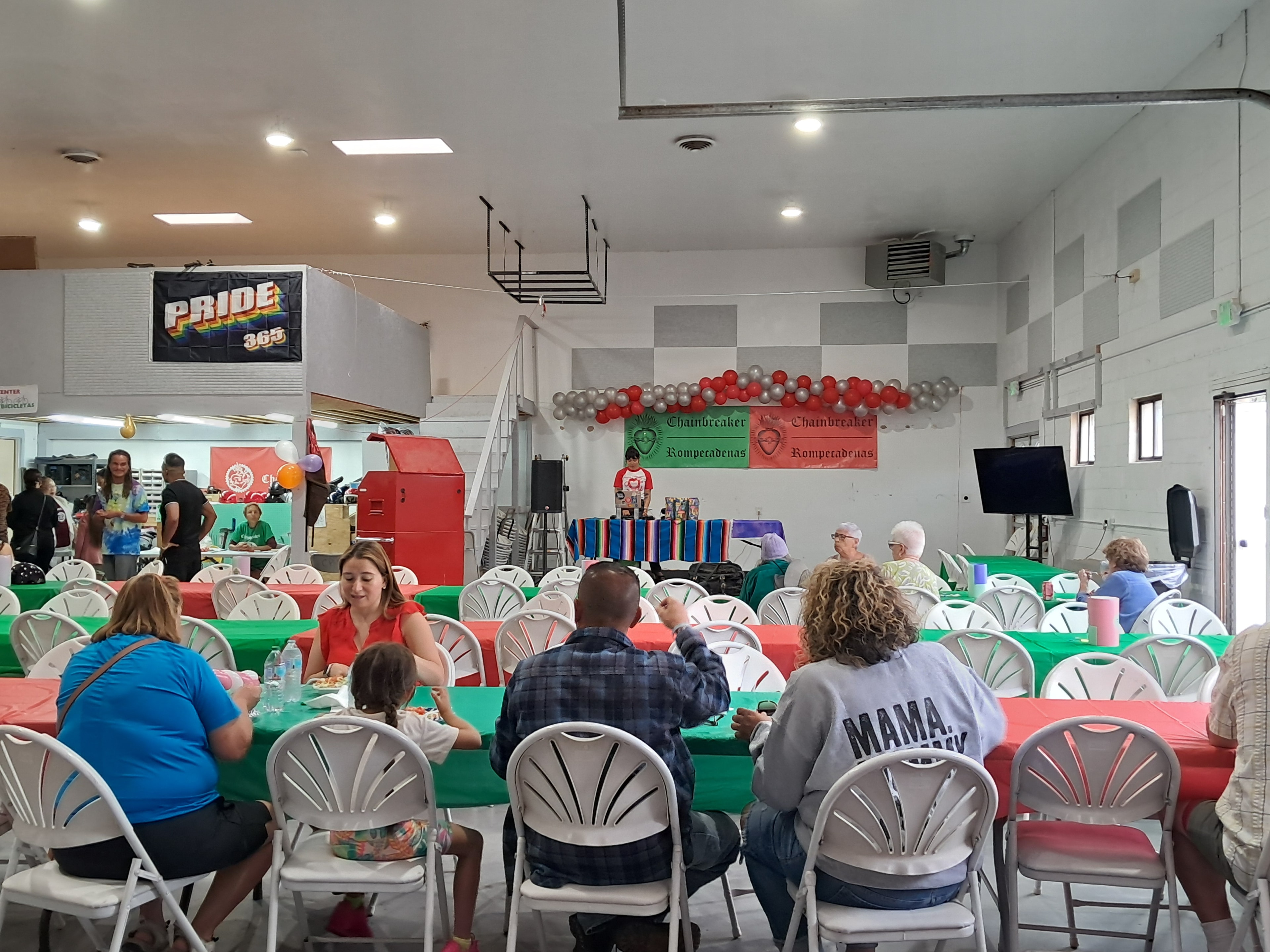
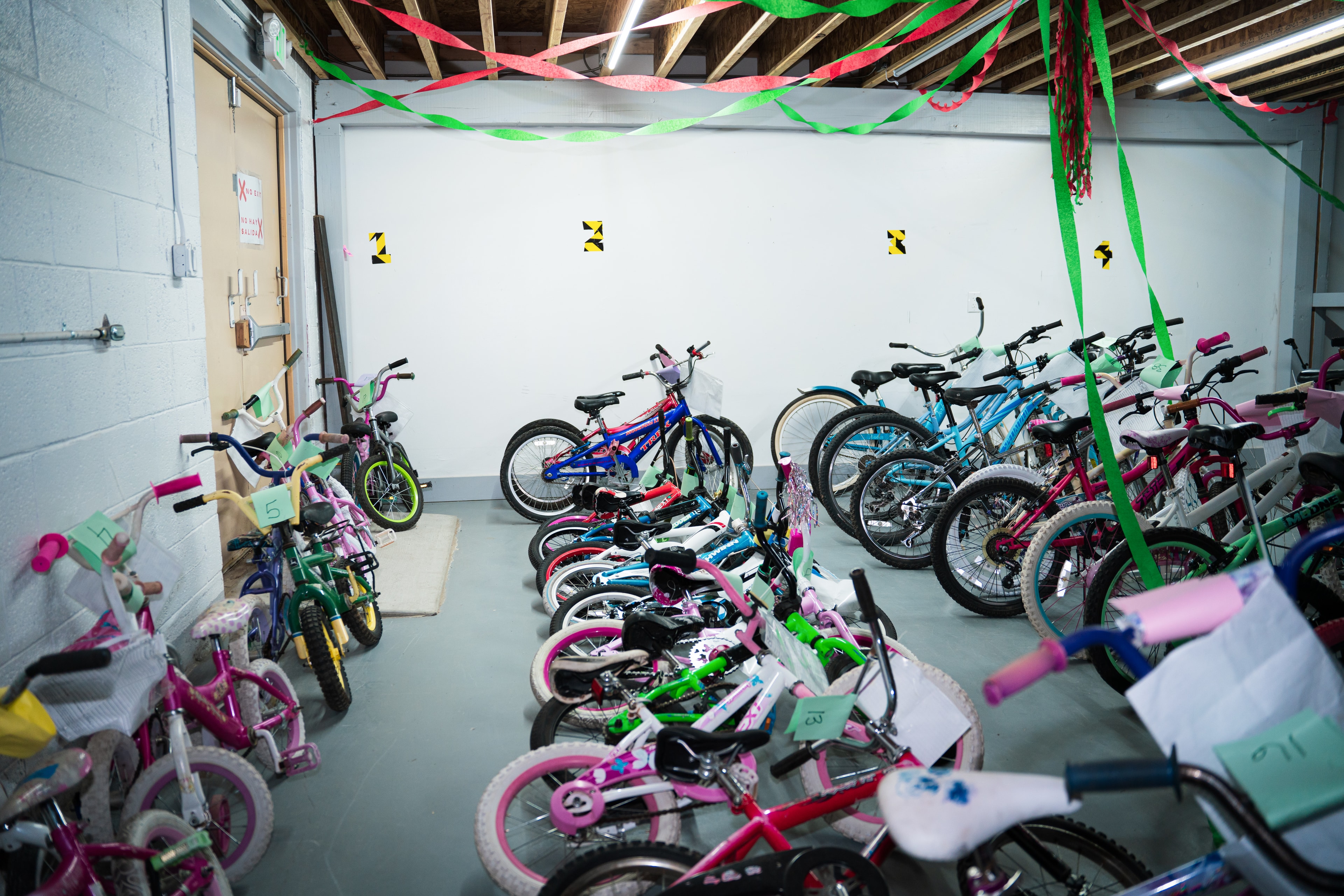
Chainbreaker’s headquarters is a center for organizing—and bikes.
Like their peers in Minneapolis found, some traditional funding options were off the table—as Tomás notes, “there's just no way we could have gone to Wells Fargo and said, hey, we want to start a land trust and buy our building, because we want to build strength so we can undermine your destruction of the world.” And while there was no shortage of interest in and excitement for what Chainbreaker was doing in Santa Fe, they needed real commitments. “There were so many people that said, ‘maybe, but I don't want to be the first person that says yes to you.’ Right To The City, with its loan fund, had the guts to be the first one to say yes.” Once that happened, the rest of the capital stack for the building purchase fell into place.
"They weren't counting on us being part of a movement."
This moment of crisis—and opportunity—illustrates a lot about Right to the City’s interest in developing financial capacity as an organization dedicated to grassroots organizing. For Mike Leyba, “part of what makes us unique is that we are not trying to finance our way out of a non-just system.” There are, no doubt, compelling reasons why more financial assets should flow towards funds that create non-extractive opportunities for community ownership. Mike notes that:
The hope is that we're able to find mission aligned investors that have a vested stake in affordable housing all across the country. Philanthropy should be moving program-related investments toward affordable housing. Anchor institutions, like hospitals or universities, should be moving their investment dollars into investments that advance the social outcomes of residents in the neighborhood.
And certainly, as this funding is assembled, deployment won’t be an issue. “Just among our member organizations,” Mike explains, “there are tens of millions of dollars of projects that are being built or acquired or moved right now, today, and that will need capital support.” But even though the need is clear, Right to the City is not looking to simply be a conduit for financial resources:
Our work goes beyond the deployment of capital. We deploy the capital, we work to get the project going, but we also fight to create new subsidy streams, new affordable housing dollars that can and should be directed toward community use, like the ones that we're doing. Our job is to both do everything we can with the means that we have through our loan fund, but also to fight, to compel the state to provide what it should be providing for people, which is a stable roof over their head.
Tomás, who also has served as the chair of Right to the City’s board, talks about this as “trans-local” organizing, in which place-based campaigns can be amplified to a national level:
Networks around the country, like Seed Commons and Right to the City, recognized this is a movement moment, because what we're doing in Santa Fe has implications. 64 acres of land in the middle of a city is not something to sneeze at. If we win on this, it will help build momentum in other places. A victory in Santa Fe is a victory for the movement, and I think they weren't counting on us being part of a movement.
Non-extractive movement-aligned capital is catalytic funding—not only unlocking further streams of impact investment, but creating proofs of concept that widen the terrain of organizing, making new demands possible. A billion dollars put into affordable housing would not be nothing, but it would be a drop in the bucket compared to the scale of the problem nationally. But if that billion dollars was deployed alongside and in alignment with deep organizing to advance real community control, the impact could be transformative. $100 million might be a few buildings in a larger city, but in Santa Fe that money, deployed in and around this central 64 acres, could start transforming the entire center of the city, and “with the community organizing push behind it,” really make the city invest public resources, including land, in the model—and in the process create a beacon for permanent affordability, showing nationally what is possible.
In the middle of their fight to save their headquarters and lay the foundation for a major anti-displacement initiative, Tomás notes that Chainbreaker also played a key role in a major fight for low-income workers across the city. Their organizing helped secure municipal legislation that indexes the local living wage to the actual cost of housing, automatically. Being able to turn to a movement-aligned network for the first part of the capital stack needed to purchase their building was one of the things that made this important additional victory possible, because they were able to dedicate time to the organizing opportunity, instead of simply being “out there talking to Wells Fargo, begging for money for this building.” Even the paperwork, Tomás notes, was calibrated to the needs of busy organizers:
The loan that we filled out for Right to the City was human-based, it was clear, it was easy to understand. So it's not just the actual money, it's understanding that you're trying to communicate with people that aren't investment bankers. I had set aside something like half a day just for the paperwork, and we got it done in an hour. That's an indicator to me of living values in a way that's really important. It might feel like a small piece of the puzzle, but for us, it was huge in that moment.
The culture of non-extraction that Right to the City has helped build as a member of Seed Commons is a critical part of the kind of shared financial infrastructure that on the ground movements need to institutionalize victories, seize opportunities, and lay foundations for bigger transformations. It’s about deploying capital not just to make good projects that help people live more dignified lives happen, but doing so in a way that sets those projects up to catalyze the next win, and the one after that.
Back in Minneapolis, César explains how this is working at Sky Without Limits:
Folks at the cooperative, they don't just get to be part of this amazing project, but they become leaders and organizers to continue this movement throughout the cities. It's so beautiful. We're already seeing cross-pollination between campaigns. We already have a few leaders here in the cooperative that are doing work building tenant unions, other folks that are working to try to figure out housing for other people in their community. So we're seeing not just this amazing place to live, but a place that provides real leadership opportunities for the people living in the cooperative.
And when a real alternative is shown to be a real concrete possibility, that makes the organizing easier, because you have unlocked the radical imagination of a better world. As César notes,
Right now, here in the Twin Cities, IX is building what we call tenant unions. We're organizing buildings all over the Twin Cities. We're seeing the interest in the possibility of gaining more territory. We are seeing so much interest, and so we're hoping to capture a lot of buildings, where people are organized, and at some point have the opportunity to purchase their building. And then we're able to bring this model for a democratic process where people can make their own decisions as members and through the board they elect, just like what we're doing at Sky Without Limits.
If the financial infrastructure built to accompany movements can scale with them, the effect is potentially huge. As less of the capital movements need flows through traditional extractive financial institutions, the more those movements are able to act autonomously, with more financial resources circulating in structures designed to sustain infrastructure and build real community ownership. “We're fighting against this huge capitalistic machine,” César explains. “This is not about our own personal gain, it's about our community, because once we are in community, we're a lot more powerful.”